During this terrible pandemic, state leaders have been at the forefront of the response…
Is there a gender gap in progressive ambition among male and female municipal officials?
Alejandra Aldridge
,
Adam M. Dynes
,
Anna Nakaya
| Feb 17, 2026

In democracies like the United States that lack formal interventions (such as gender quotas) to increase women’s representation, research seeking to understand why women continue to be underrepresented in elected office has focused on two key factors: differences between men and women in their ambitions to run for office and the gender composition of the pool of potential candidates to run for office.
For this project, we bring together both of these factors in studying an overlooked but potentially important source of candidates for higher office in the US: elected municipal officials, like mayors and city councilors. Rather, the literature on the pipeline to higher office has focused on high-status careers or elected state legislators’ path to federal office. As one of the lowest levels of government, municipal office can serve as an entry point into electoral politics due to their higher accessibility with over 125,000 elected positions in municipal governments in the US. As such, many members of the US Congress have previously held positions in local government, 33% in 2019.
A major contribution of this project is that we combined a survey of 2,800 elected municipal officials’ ambitions for higher office with data on whether they actually ran for higher office in the 8 years since being surveyed. This combination is important because past work that has examined whether female candidates for local and state offices re-run for office at similar rates as their male counterparts cannot account for whether these female and male candidates had similar levels of ambition. For instance, what if the re-running rate is similar for men and women, but female candidates actually had more ambition?
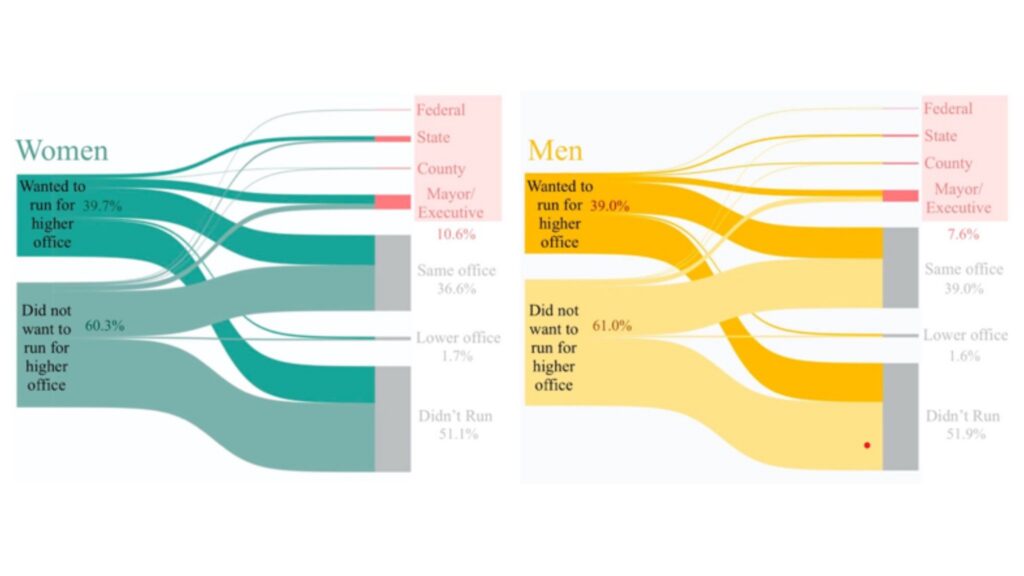
This figure, representing our initial findings, shows that male and female elected municipal officials in 2016 had similar interest in running for higher office (about 39% did,). And then by 2024, see the right side of each panel, women were slightly more likely than men to run for a higher office (at rates of 11% compared to 8%). The rate of not running again for any office is similar for both women (51%) and men (52%) and ever so slightly different for running for the same office (37% for women and 39% for men). The small difference between female and male municipal officials who seek higher office holds even when accounting for their expressed ambition in 2016 and other factors that might affect their propensity to run for higher office.
This finding suggests that once women overcome the hurdle to run for and win municipal office, they do not face sufficient hurdles to prevent those who are interested in running for higher office from doing so anymore so than their male counterparts. Thus, our work confirms past work that argues that a major challenge for increasing femal representation is getting more women into these candidate pools, and this holds for municipal office were women made up only 25% of city councilors and mayors in our sample.